

Arthroscopic ACL Reconstruction
Arthroscopic ACL Reconstruction is a minimally invasive surgical procedure used to restore stability to the knee when the anterior cruciate ligament (ACL) is severely damaged or torn. The procedure aims to reconstruct the injured ligament and help patients return to their daily activities, sports, and active lifestyle with appropriate rehabilitation.
What Is an ACL Injury?
The anterior cruciate ligament (ACL) is one of the major ligaments inside the knee. It helps control forward movement and rotational stability of the knee joint. ACL injuries commonly occur during sports involving sudden changes in direction, twisting, jumping, or awkward landings. They can also occur following accidents or other traumatic injuries.
A significant ACL tear may result in:
- Knee instability or a feeling that the knee is giving way
- Pain and swelling following an injury
- Difficulty with sports or physically demanding activities
- Reduced confidence while walking, running, or changing direction
- Associated injuries to structures such as the meniscus or other knee ligaments
When Is ACL Reconstruction Recommended?
Treatment depends on factors such as the extent of the ligament injury, knee stability, activity level, age, associated injuries, and individual treatment goals.
ACL reconstruction may be considered for patients with:
- A complete or functionally significant ACL tear
- Persistent knee instability despite appropriate non-surgical treatment
- Recurrent episodes of the knee giving way
- Associated meniscus or ligament injuries
- A desire to return to pivoting or high-demand sports and activities
A detailed clinical examination and appropriate imaging, such as an MRI scan, may be used to assess the ACL and identify associated injuries.
How Is Arthroscopic ACL Reconstruction Performed?
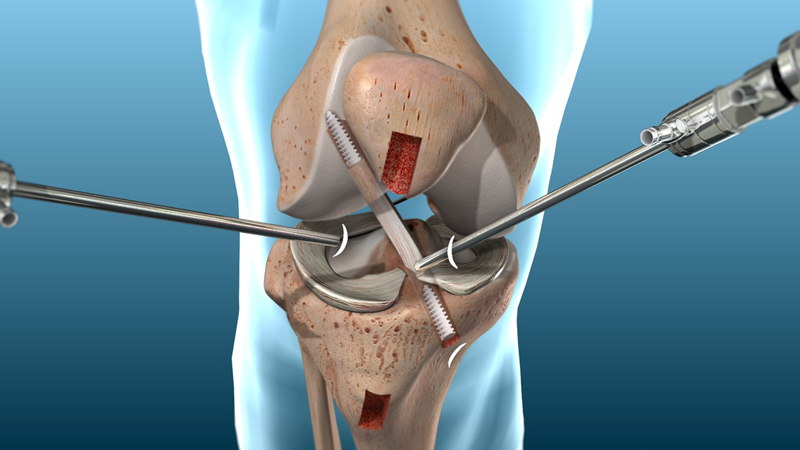
ACL reconstruction is performed using arthroscopy, in which a small camera is inserted through small incisions around the knee. This allows the surgeon to examine the internal structures of the joint.
During the procedure:
- The knee joint is examined arthroscopically.
- The damaged ACL is assessed and the injured tissue is addressed as appropriate.
- A suitable graft is prepared to reconstruct the ligament.
- Tunnels are created in the appropriate areas of the thigh and shin bones.
- The graft is positioned to reproduce the function of the ACL.
- The graft is securely fixed in place.
- Associated injuries, such as certain meniscus tears, may be treated during the same procedure when appropriate.
The exact surgical technique and graft choice are determined according to the patient's injury, anatomy, activity requirements, and clinical assessment.
Benefits of Arthroscopic ACL Reconstruction
When appropriately indicated, ACL reconstruction can help:
- Restore functional stability of the knee
- Reduce episodes of knee giving way
- Support a gradual return to physical activities
- Address associated injuries during the same procedure when required
- Facilitate a structured rehabilitation program
The outcome of surgery depends not only on the reconstruction but also on post-operative rehabilitation, muscle strength, movement control, and gradual return to activity.
Recovery After ACL Reconstruction
Recovery is a gradual process and varies from patient to patient. Rehabilitation usually begins soon after surgery under the guidance of the treating team and physiotherapist.
The rehabilitation program generally focuses on:
Early Phase
Controlling pain and swelling, restoring knee movement, and activating the quadriceps muscles.
Strength & Mobility Phase
Progressively improving muscle strength, balance, coordination, and knee function.
Functional Training Phase
Developing movement control and gradually introducing activity-specific exercises.
Return-to-Sport Phase
For athletes, progressive sport-specific training and functional assessment may be used before returning to competitive activities.
Returning to sports should be based on clinical and functional recovery rather than simply the passage of a fixed number of weeks or months.
Why Choose Dr. Raja Nadar for ACL Reconstruction?
Dr. Raja Nadar has specialized training and clinical experience in knee arthroscopy and joint-related procedures. His fellowship training includes Shoulder and Knee Arthroscopy under Dr. Abhay Narvekar at P.D. Hinduja and Global Hospitals, as well as Foot & Ankle Fellowship training with exposure to Knee Arthroscopy.
His academic work has also included research and presentations related to arthroscopic management of rotator cuff injuries and other orthopaedic conditions, reflecting his involvement in arthroscopic and sports-related orthopaedic care.