


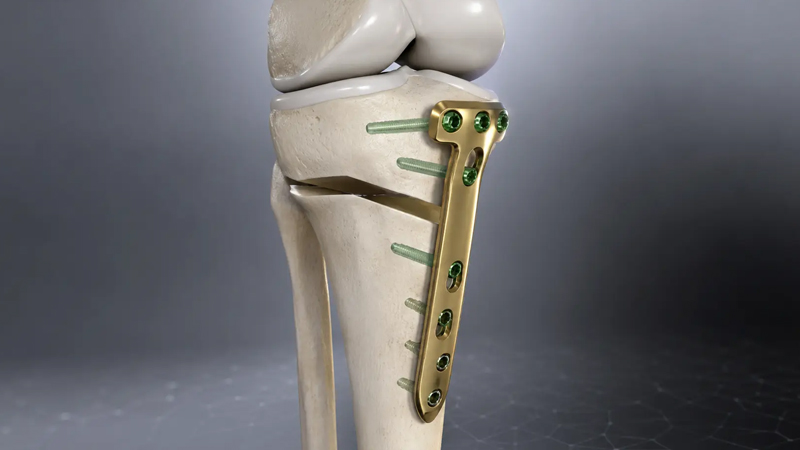
HTO for Knee Preservation
High Tibial Osteotomy (HTO) is a surgical procedure used to realign the knee joint in patients with medial (inner) compartment knee arthritis associated with a varus (bow-legged) deformity. By correcting the mechanical axis of the leg, HTO shifts load away from the damaged compartment, reduces pain, improves function, and may slow the progression of arthritis — helping younger, active patients preserve their own knee for as long as possible.
Understanding Knee Alignment and Arthritis
The knee is divided into compartments. In a well-aligned knee, body weight is distributed evenly across both the medial and lateral compartments. When the leg has a varus alignment (bow-leg), a disproportionate amount of load is concentrated on the medial compartment. Over time, this unequal loading accelerates cartilage wear on the inner side, leading to pain, stiffness, and progressive osteoarthritis.
Who Is a Candidate for HTO?
HTO is generally considered for:
- Younger, active patients (typically under 60) with medial compartment knee arthritis
- Patients with a varus knee deformity contributing to medial overload
- Those who wish to remain active and delay or avoid joint replacement surgery
- Patients with mild to moderate arthritis in one compartment, with a relatively intact lateral compartment
- Individuals who have not responded adequately to non-surgical treatment
How Is HTO Performed?
The most commonly performed technique is the medial opening-wedge HTO. During the procedure:
- A carefully planned cut (osteotomy) is made in the upper tibia (shin bone) below the knee joint.
- The cut is gradually opened to a calculated degree that corrects the mechanical axis of the limb.
- The created gap is stabilised with a plate and screws to hold the correction securely while the bone heals.
- Bone graft or a bone substitute may be used to fill the gap and support healing.
Detailed pre-operative planning using full-length standing X-rays is essential to calculate the precise correction required for each patient.
Benefits of HTO
- Preserves the patient's native knee joint
- Reduces pain and improves function
- Allows continuation of physical activity and sport
- May slow the progression of medial compartment arthritis
- Does not preclude joint replacement surgery in the future if required
Recovery After HTO
Early Phase
Weight-bearing is typically restricted initially, with gradual progression under physiotherapy guidance. Crutches are used during this period.
Bone Healing Phase
Progressive weight-bearing resumes as bone healing is confirmed on X-ray, usually over several weeks.
Rehabilitation Phase
Physiotherapy focuses on restoring range of motion, muscle strength, balance, and functional movement.
Return to Activity
Return to full activity and sport is gradual and guided by clinical and radiological progress. Full recovery can take several months.
Why Choose Dr. Raja Nadar for HTO?
Dr. Raja Nadar has specialised training and clinical experience in orthopaedic surgery, encompassing joint preservation procedures, arthroscopy, and joint replacement. His approach to knee care includes identifying the most appropriate solution for each patient — including osteotomy for suitable candidates who wish to preserve their native knee joint for as long as possible.