

Arthroscopic Meniscus Repair
Arthroscopic Meniscus Repair is a minimally invasive surgical procedure used to treat tears of the meniscus — the C-shaped cartilage structures inside the knee that act as shock absorbers and stabilisers. Where appropriate, repairing rather than removing the torn meniscus helps preserve joint function and long-term knee health.
What Is a Meniscus Injury?
Each knee has two menisci — the medial (inner) and lateral (outer) meniscus. They distribute load across the knee, cushion impact, and contribute to joint stability. Meniscus tears can occur during sport due to twisting or pivoting movements, or in older patients through gradual degeneration.
Common symptoms of a meniscus tear include:
- Pain along the inner or outer side of the knee
- Swelling and stiffness in the knee joint
- A clicking, catching, or locking sensation
- Difficulty fully straightening or bending the knee
- Pain worsening with squatting, twisting, or prolonged activity
When Is Meniscus Repair Recommended?
Treatment of a meniscus tear depends on the type, location, and extent of the tear, along with the patient's age, activity level, and overall knee health. Repair is generally favoured over removal when the tear is in a well-vascularised zone and the tissue quality is suitable.
Repair may be considered when:
- The tear is located in the peripheral (outer) zone with good healing potential
- The patient is young and active
- The tear pattern is suitable for stable fixation
- Associated ligament injuries are being treated simultaneously
How Is Arthroscopic Meniscus Repair Performed?
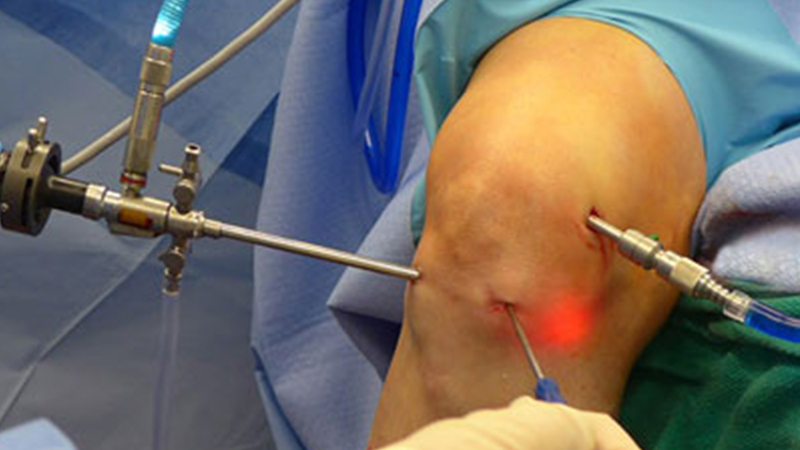
The procedure is carried out using arthroscopy, where a small camera is introduced into the knee through small incisions, allowing direct visualisation of the meniscus and surrounding structures.
During the procedure:
- The entire knee joint is examined arthroscopically.
- The meniscus tear is assessed for size, location, pattern, and tissue quality.
- The torn edges are prepared to encourage healing.
- Sutures or fixation devices are used to hold the torn edges together in their correct anatomical position.
- Any associated injuries within the knee may be addressed during the same procedure.
Benefits of Meniscus Repair
- Preserves the meniscus and its shock-absorbing function
- Reduces the risk of early cartilage wear and osteoarthritis
- Restores knee stability and function
- Minimally invasive with small incisions
- Allows simultaneous treatment of other knee injuries
Recovery After Meniscus Repair
Recovery after meniscus repair requires a careful and phased approach to allow adequate healing of the repaired tissue.
Early Phase
Weight-bearing and range of motion are typically restricted initially to protect the repair. Crutches may be used during this period.
Progressive Mobility Phase
Gradual restoration of knee movement and cautious weight-bearing is introduced as healing progresses.
Strengthening Phase
Progressive strengthening of the thigh and surrounding muscles is incorporated to support the knee.
Return to Activity Phase
Functional and sport-specific exercises are introduced before return to full activity, guided by clinical assessment.
Recovery from meniscus repair is generally longer than after meniscus trimming, reflecting the need to allow tendon healing. A dedicated rehabilitation programme is essential to a good outcome.
Why Choose Dr. Raja Nadar for Meniscus Repair?
Dr. Raja Nadar has specialised clinical training in knee arthroscopy and has experience managing a range of intra-articular knee conditions including meniscus pathology. His training and academic work in arthroscopic orthopaedic care underpin his approach to preserving the natural structures of the knee wherever possible.